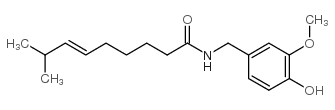
CapsaicinCAS号: 404-86-4分子式: C18H27NO3分子量: 305.41描述纯度储存/保存方法别名外观可溶性/溶解性靶点In vitro(体外研究)In vivo(体内研究)参考文献
| 产品描述 | |
| 描述 |
Capsaicin is an active component of chili peppers. It selectively binds to TRPV1 which is a heat-activated calcium channel. Capsaicin causes the channel to open below 37 °C This is why capsaicin is linked to the sensation of heat. |
| 纯度 |
98%
|
| 储存/保存方法 |
Store at -20℃ for one year(Powder);Store at 2-4℃ for two weeks;Store at -20℃ for six months after dissolution.
|
| 基本信息 | |
| 别名 |
辣椒素;(E)-Capsaicin;8-Methyl-N-vanillyl-trans-6-nonenamide
|
| 外观 |
白色粉末或晶体
|
| 可溶性/溶解性 |
DMSO :≥ 44 mg/mL
|
| 生物活性 | |
| 靶点 |
TRP Channel
|
| In vitro(体外研究) |
Capsaicin is an agonist of transient receptor potential vanilloid subtype 1 (TRPV1), which is expressed in nociceptive sensory neurons and a range of secretory epithelia, including salivary glands. Capsaicin activates TRPV1, which modulates the permeability of tight junctions (TJ) by regulating the expression and function of putative intercellular adhesion molecules in an ERK-dependent manner. Capsaicin is found to inhibit the growth and proliferation of FaDu cells in a dose- and time-dependent manner. Cells treated with 50, 100, 200, and 300 µM Capsaicin show an augmented decrease in cell growth as the Capsaicin dose increases. In addition, the percentage of viable cells decreases as the incubation time increases. The observed IC50 value is around 150 µM.
|
| In vivo(体内研究) |
Capsaicin (CAP)-treated animals (Group IV) show increased DNA fragmentation suggesting apoptosis when compare with B(a)P-induced lung cancer-bearing animals (Group II) that show reduced DNA fragmentation. CAP-treated Group IV animals show markedly increased expressions of p53, Bax and caspase-3 with remarkable decrease in the levels of anti-apoptotic protein Bcl-2, when compare with B(a)P-administered lung cancer animals of Group II. Capsaicin causes a dose-dependent reduction of tear secretion in female Wistar/ST rats. Significant effects are observed at doses of 20, 50 and 100 mg/kg. In addition, Capsaicin also causes corneal lesions, and significant effects are observed at doses of 50 and 100 mg/kg.
|
| 参考文献 | |
| 参考文献 |
1. Shaqura M, et al. Neuropharmacology. 2014 Oct;85:142-50. 2. Jeong KY, Seong J. J Neurol Sci. 2014 Jun 15;341(1-2):58-63. |
分子结构图